Top Features to Look for When Buying a Home Security System
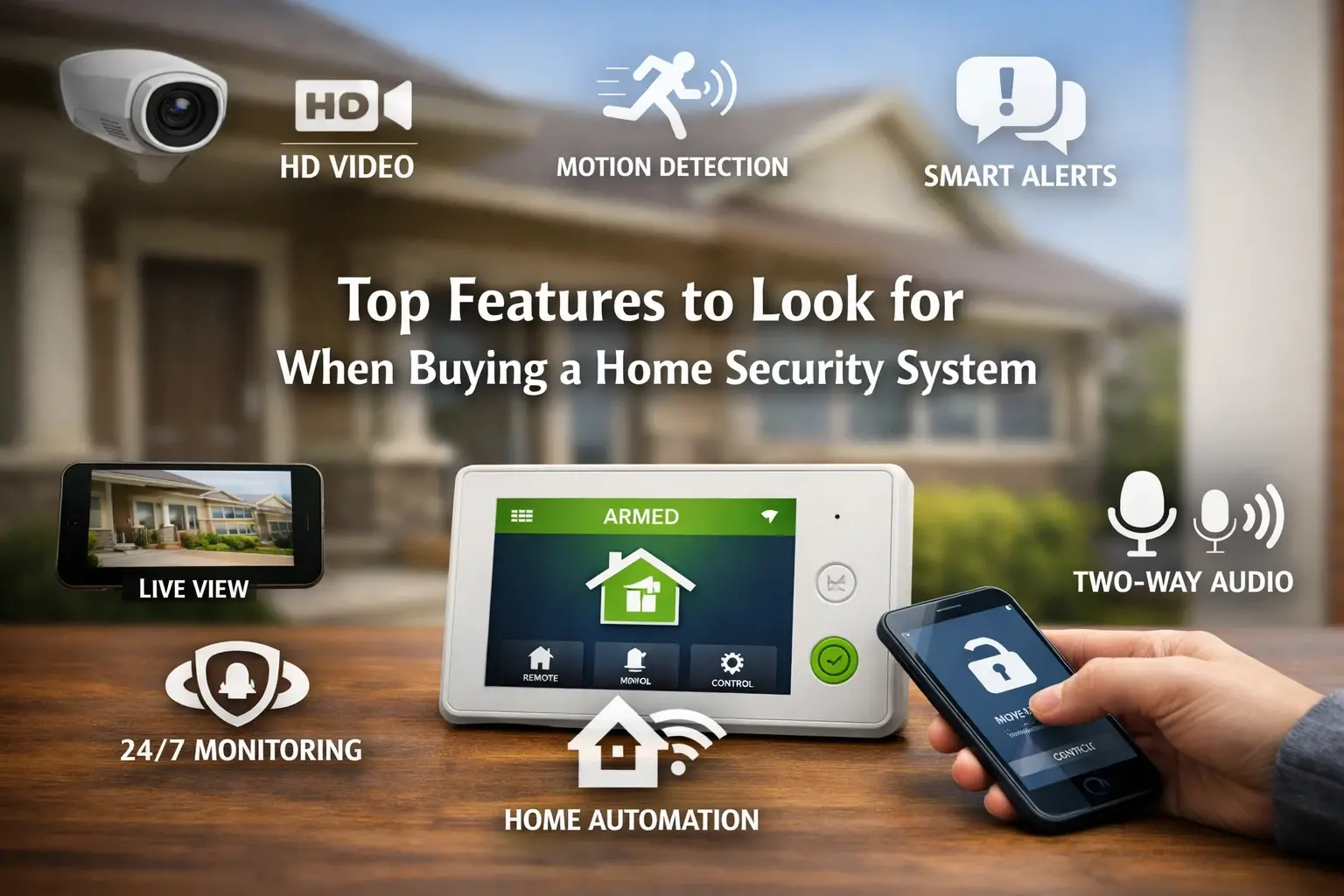
The most important features to look for in a home security system are: professional 24/7 monitoring with a documented response time, cellular backup connectivity so the system stays online if your Wi-Fi or power goes out, AI-powered camera detection that distinguishes people from animals and vehicles, a backup battery in the base station, and smart home integration with the platforms you already use. Secondary features worth evaluating include two-way audio on cameras and entry panels, cloud and local video storage options, contract flexibility, and whether the system can expand as your coverage needs grow. Every other feature on a spec sheet — and there are many — falls into either "nice to have" or "you'll never use it."
Key Findings
Feature | Why It Matters | Minimum to Look For |
|---|---|---|
Professional monitoring | Dispatches emergency services when you can't | <35-second average response time |
Cellular backup | Keeps the system online when Wi-Fi or power fails | Built into the base station, not add-on hardware |
AI camera detection | Eliminates false alerts from pets, wind, and headlights | Person/vehicle/animal/package classification |
Backup battery | System functions during power outages | 24-hour minimum capacity in the base station |
Entry sensors | First line of physical deterrence | Door and window sensors on all ground-level access points |
Motion detectors | Interior detection layer for inside-home movement | PIR-based, adjustable sensitivity |
Smart home compatibility | Controls and automation from one app | Alexa, Google Home, Apple HomeKit — at least one |
Video storage | Evidence and review capability | 30+ days cloud or local storage option |
Contract terms | Protects you if circumstances change | Month-to-month option available |
Scalability | Add devices without switching systems | Open ecosystem, expandable sensor count |
Introduction
Most people shopping for a home security system start in the wrong place. They look at brand rankings, or they go straight to price, or they pick whatever their neighbor has. None of those are terrible starting points — but none of them answer the actual question, which is: what do I need this system to do?
The home security market in 2026 is saturated with capable hardware. At least 30 major systems are tested and ranked by independent reviewers every year. What separates them isn't whether they have cameras or sensors — they all do. What separates them is how those cameras behave when it's 2 a.m. and something trips the sensor. How fast does the monitoring center respond? Does the system stay online if your power goes out? Does the camera tell you it's a person near your side door, or just that "motion was detected"? Does the alarm still work if someone cuts your internet first?
Those are the questions that turn a list of features into an actual buying framework. This guide works through every feature worth evaluating — in priority order — and explains what each one does, what to look for in the specs, and where the hidden trade-offs live.
Feature 1: Professional Monitoring — The One You Can't Skip
Here's the thing about professional monitoring that most system comparisons understate: the monitoring isn't just a safety net. It's the core function. Everything else — sensors, cameras, smart locks — is the detection layer. Professional monitoring is the response layer, and without it, detection is just noise you have to respond to yourself.
When your alarm triggers and you're unreachable — driving, in a meeting, asleep — the monitoring center is what happens next. A trained operator contacts you, verifies what's happening, and if they can't reach you or confirm a false alarm, dispatches emergency services. That chain of events is what transforms a home security system from an expensive notification app into actual protection.
What to look for:
Response time. This one has a number attached to it, and the number matters. Security.org's 2026 testing logged ADT's six monitoring centers at an average of 28 seconds from alarm to response. SimpliSafe averaged 31 seconds across 20 simulated break-ins. Vivint came in at 33 seconds. Five seconds sounds small. During an active intrusion, it isn't. Ask providers for their documented average response time — not a marketing claim, an actual measured figure.
Redundant monitoring centers. A single monitoring facility is a single point of failure. ADT's network of 12 monitoring centers across North America means that a regional outage, a disaster, or a facility failure doesn't leave your home dark. Most competitors operate one or two centers. For the majority of homeowners, this never matters. If you're in a storm-prone region or simply want the infrastructure depth, it's worth knowing.
Video verification. The most consequential upgrade in professional monitoring over the past three years is video verification — where the monitoring agent can access a live camera feed to visually confirm whether an intrusion is actually happening before dispatching emergency services. SimpliSafe's Intruder Intervention feature goes further: agents can speak directly through the camera to warn off an intruder in real time. Both features reduce false dispatches and produce faster, more credible emergency responses.
Self-monitoring as a backup, not a primary. Self-monitoring — where alerts go to your phone, and you decide whether to call 911 — is available on most platforms and is genuinely useful as a secondary layer. As a primary monitoring strategy, it relies on you being reachable and alert at all times. For most households, that's not a realistic standard. If budget is the constraint, some systems like Abode offer hybrid plans where you can switch between self-monitoring and professional monitoring without a contract.
Feature 2: Cellular Backup — The Feature That Protects the System Itself
Here's something the glossy spec sheets don't highlight: an alarm system that runs only over your home Wi-Fi or a landline phone connection can be defeated before it's ever triggered. Cut the internet line. Kill the power. The system goes dark.
Cellular backup solves this by giving the system an independent communications path — the same cellular network your phone uses — so it can contact the monitoring center even when your home's power and internet are both down. It's the feature that protects the system from the most elementary countermeasures, and it should be non-negotiable.
What to look for:
Built into the base station, not an add-on. Several systems offer cellular backup but bury it behind a hardware add-on purchase or a higher monitoring tier. The cleanest implementations — ADT, Vivint, SimpliSafe on paid plans, Cove — build cellular connectivity into the base station from the start. It's always on, always failsafe. If a system's cellular backup requires you to buy a separate cellular communicator module, treat that as a mark against the overall design.
Cellular backup and Wi-Fi together. The best base stations run Wi-Fi as the primary connection and cellular as the fallback. This isn't redundancy for the sake of it — it means that a brief internet outage doesn't generate a false alert or leave a coverage gap, while a deliberate interference attempt or a storm-caused outage still routes through cellular.
Note on self-monitoring plans. SimpliSafe's self-monitoring tier, for example, does not include cellular backup — meaning the system relies entirely on your home internet connection. This is a documented limitation worth knowing before choosing a plan tier based on cost alone. Professional monitoring plans at most major providers include cellular backup as standard.
Feature 3: AI Camera Detection — The Difference Between Useful and Annoying
A motion-detecting camera that sends you an alert every time a car passes, a tree branch moves in the wind, or your dog walks through the living room isn't a security tool. It's a notification machine. And after three days of notifications, you'll start ignoring them — which defeats the entire point.
AI-powered detection solves this problem by teaching the camera to classify what it sees rather than just detecting that something moved. Modern AI cameras distinguish between a person, a vehicle, an animal, a package, and background motion with near-perfect accuracy. Independent 2023 research on AI camera performance reported a 99.4% vehicle detection rate and only 1.77% false alarms from properly configured systems. The practical effect: when your phone buzzes, it actually means something happened.
What to look for:
Person, vehicle, animal, and package classification. The baseline for AI detection in 2026 should cover all four categories. Systems that only distinguish "person vs. non-person" still generate alerts for every deer, cat, or UPS truck in the driveway. Package detection specifically is increasingly valuable — 71% of U.S. adults want security features that help prevent package theft, and a camera that can flag a package drop and then flag when someone approaches it without picking it up is delivering genuinely useful intelligence.
On-device vs. cloud processing. AI that runs locally on the camera hardware (edge AI) processes faster and keeps working during an internet outage. AI that runs in the cloud tends to have richer features but requires a subscription tier to access them and stops working if connectivity fails. The key distinction is whether core AI features remain functional during an internet outage — an important question for any household that cares about system reliability in real-world conditions.
Facial recognition at higher tiers. ADT's top-tier monitoring plan includes Google Nest Cam integration with 2K HDR video and AI-powered facial recognition — meaning the system learns the faces of household members and treats their presence differently from that of an unknown person. This isn't essential for most homeowners, but for households with frequent visitors or shared properties, it meaningfully reduces alert fatigue.
Customizable detection zones. The best cameras let you define specific areas of the frame where detection is active — so you can exclude the public sidewalk in front of your house while still monitoring the driveway and front door approach. Ring Alarm's privacy zones feature is one of the cleanest implementations of this.
Feature 4: Entry Sensors and Motion Detectors — The Physical Foundation
Cameras and monitoring are the visibility layer. Entry sensors and motion detectors are the detection layer — the hardware that actually identifies when a boundary has been crossed.
Entry sensors are magnetic contact sensors mounted on doors and windows. When the door or window opens while the system is armed, the circuit breaks and the alarm triggers. They're simple, reliable, and the most fundamental component of any security system.
Motion detectors — typically passive infrared (PIR) sensors — detect the heat signature of a moving body. They're most commonly used as a secondary interior layer: if someone gets past the entry sensors without triggering them (an unlocked window left open, a door held long enough to disarm), the motion detector in the hallway catches the movement inside.
What to look for:
Coverage of all ground-level entry points. The first job when setting up a system is mapping every realistic entry point: front door, back door, ground-floor windows, sliding patio doors, attached garage entry, and basement access if applicable. Entry sensors on every one of these is the minimum. A starter kit that covers two doors and nothing else is a starting point, not a finished system.
Pet-immune motion detectors. PIR sensors detect body heat and movement. A 60-pound dog moving through a room at night reads as a body-heat signature to a standard PIR detector. Pet-immune motion detectors use weight-based or height-adjusted detection calibrated to ignore animals below a certain mass threshold. For households with pets, this is an essential spec, not an optional upgrade.
Glass break detectors. A common entry method that neither door sensors nor motion detectors catch on their own: breaking a window without opening it. Glass break detectors — acoustic sensors that respond to the specific frequency pattern of breaking glass — cover this gap. They're not standard in every starter kit, but they're worth adding for ground-floor rooms with accessible windows.
Feature 5: Backup Battery in the Base Station
The base station is the hub that everything connects to. It communicates with sensors, processes alerts, and routes alarms to the monitoring center. If it loses power, the entire system goes down.
A backup battery in the base station keeps the hub operational during a power outage. The standard to look for is 24-hour backup capacity — enough to cover most power interruptions without leaving the home unprotected. Several systems exceed this: SimpliSafe's base station carries a 24-hour battery, and ADT's base includes backup power as standard across its platforms.
This pairs directly with cellular backup. If both are present — cellular connectivity and battery backup in the base station — the system can operate through a power outage and an internet outage simultaneously. That combination covers the two most common failure modes a home security system faces.
What to look for:
Battery capacity specified in hours, not vague "backup power" claims. Ask the provider specifically how long the system operates on battery. Marketing language like "includes backup battery" without a duration figure doesn't give you enough to evaluate.
Battery replacement schedule. Backup batteries in base stations don't last forever. Most lithium backup cells need replacement every three to five years. A system with a sealed, non-user-replaceable battery is a design liability over a five-year ownership horizon.
Feature 6: Smart Home Integration
Security systems that exist in isolation from everything else in your home create friction. You check the ADT app to see the camera, a separate app to check the Ring doorbell, and another app to lock the smart lock. The practical outcome is that most of these apps get checked less often over time.
Smart home integration — where your security system talks to your voice assistant, your locks, your thermostat, and your lights through a shared platform — removes that friction. The system fits into how you already live rather than adding another parallel layer.
What to look for:
Platform compatibility. The three dominant smart home platforms are Amazon Alexa, Google Home, and Apple HomeKit. A system that works with all three gives you maximum flexibility now and future flexibility if you change devices. Vivint's platform integrates natively with Google, Alexa, and Apple. ADT's Pro Install tier connects through Google Home Premium. Ring is tightly optimized for Alexa.
Matter standard support. Matter is the industry interoperability protocol that allows devices from different manufacturers to work together on the same network. The direction in 2026 is toward easier interoperability through Matter, with Samsung announcing SmartThings support for Matter camera functionality, including live streaming, two-way communication, motion detection, and event history. For buyers who want a system that ages well and doesn't lock them into a single brand's ecosystem, Matter compatibility is a forward-looking spec worth checking.
Automation capability. The most useful smart home security features aren't just about alerts — they're about automatic responses. Lights that turn on when the exterior camera detects a person at 11 p.m. A door lock that automatically engages when the system is armed. A thermostat that adjusts when the system recognizes you've left the house. These automations are configured through the platform app and create a home that responds intelligently rather than just recording events after they happen.
Feature 7: Video Storage — Cloud, Local, or Both
A camera that records footage but doesn't store it reliably is a camera you can't use as evidence. Video storage is the feature that makes a camera system useful after an incident rather than only during it.
Two storage architectures exist in the consumer security market, and the choice between them has real implications for privacy, cost, and reliability.
Cloud storage uploads footage to the provider's servers, where it can be accessed from any device and is protected from physical tampering at the home. Most professional monitoring plans include cloud storage at specified retention periods — 30 days is standard at mid-tier plans, with longer retention available at premium tiers. Cloud storage requires a functioning internet connection to upload and a paid subscription to maintain access.
Local storage — on-device SD cards, NVR hard drives, or network-attached storage — keeps footage on hardware you control. It doesn't require a subscription, works during internet outages, and keeps your footage out of third-party servers. The trade-off is physical vulnerability: if a burglar takes the camera or the base station, the footage goes with it.
The strongest configurations combine both. Some systems, including Eufy's standalone camera line, process AI locally and store footage on-device without requiring a subscription, with optional cloud backup for redundancy. For security-conscious homeowners who object to having their home's video footage on a corporate server, this architecture is worth seeking out.
What to look for:
Minimum 30-day retention on cloud plans. Incidents are often reviewed days after they occur. A 7-day cloud storage window — offered at some entry-tier plans — is frequently not long enough to capture footage of an event that isn't noticed immediately.
No vendor lock-in for local storage. Some systems use proprietary storage formats or hardware that only works with the manufacturer's NVR. Open standards (standard MP4, compatible with common NVR hardware) give you more control over your footage.
Feature 8: Two-Way Audio
A doorbell camera or outdoor camera with two-way audio lets you speak to whoever is at your door — or approaching your property — without opening it or being physically present. This is useful in more situations than it sounds.
The delivery driver who needs instructions on where to leave a package. The solicitor who won't leave. The visitor who arrives while you're across town. The contractor is working while you're at the office. Two-way audio converts a camera from a passive recording device into an active communication tool.
At the monitoring level, two-way audio in the panel itself — which Alder Security builds directly into its control panels — allows monitoring agents to communicate through your home's alarm hub during an event. This is meaningfully different from a camera-based interaction: the agent can address everyone in the home, confirm whether a dispatch is needed, and provide real-time guidance during a potentially threatening situation.
What to look for: echo cancellation in the audio hardware (so you can hear and speak simultaneously), a microphone sensitive enough to pick up normal speech at the door distance, and a speaker loud enough to be clearly audible outdoors.
Feature 9: Contract Terms and Cancellation Policy
This one isn't a hardware feature, but it matters as much as anything on the spec list. A three-to-five-year contract for a professionally installed system is a significant financial commitment. The early termination fee — typically several hundred dollars, sometimes calculated as a percentage of remaining contract value — creates real exposure if circumstances change: a job relocation, a sale of the home, a significant life change that makes the monthly cost unsustainable.
Before signing any contract, know specifically:
What is the ETF if I cancel in month 6? Month 18?
Can I transfer the contract to a new owner if I sell the home?
What happens to the contract if I move to a location the provider doesn't serve?
Is there a trial period during which I can cancel without penalty?
The no-contract landscape has expanded substantially. SimpliSafe offers professional monitoring on month-to-month terms with no commitment. ADT Blu has no contract. Abode offers monitoring plans starting at $6 per month with no contract. The value of professionally installed systems — particularly the technician-led security assessment and hardware quality — is real, but the contract exposure is also real. Both sides of that trade-off deserve weight in the decision.
Feature 10: Scalability
A starter kit with one hub, two entry sensors, and a doorbell camera is sufficient coverage for an apartment. It is not sufficient coverage for a 2,400-square-foot house with four entry points, a detached garage, and a backyard. The system you buy needs to grow with your coverage needs over time.
Scalability means the system can accept additional sensors, cameras, and smart devices without requiring you to switch platforms or start over. Vivint's HomeProtect Pro tier is explicitly designed as a foundation to build out over time — HomeProtect starts with a doorbell camera and core sensors, and every additional device integrates into the same hub and app. ADT's ecosystem covers an enormous range of compatible devices. SimpliSafe's modular hardware allows adding individual sensors without buying new kits.
What to look for:
Open sensor compatibility. Some systems only work with the manufacturer's proprietary sensors. Others accept sensors from multiple manufacturers that share compatible protocols. The more open the ecosystem, the more options you have as you build out coverage over time.
No per-device monitoring caps. A system that charges more per month as you add devices can turn scalability into a cost trap. The best plans charge a flat monthly rate regardless of device count — which is the norm among the major providers but worth confirming before adding hardware.
What the Research Shows: Features That Matter vs. Features That Sell
The gap between what sells systems and what makes systems effective is real, and it's worth naming directly.
Professional monitoring response time is the most consequential spec in the category, and it's the one least prominently featured in most advertising. ADT's 28-second average and SimpliSafe's 31-second average are real, tested measurements — not claims. The average value of property stolen during a residential burglary is $5,944, according to Security.org's 2026 analysis. A top-tier ADT monitoring plan costs roughly $600 per year. The math on that trade-off is clear.
AI camera detection moved from a premium feature to a standard expectation in approximately two years. In 2026, the most meaningful upgrades are not higher resolution or louder sirens — they are AI-driven detection that reduces noise, faster and more reliable connectivity, better privacy controls, and monitoring that can actually trigger a response when it matters. Buyers who focus on camera megapixel counts or siren decibels while ignoring AI classification accuracy are optimizing for spec sheet appeal rather than functional performance.
The shift toward subscription-free AI is also meaningful for budget-conscious buyers. Manufacturers are now embedding advanced AI directly into cameras — features like person, vehicle, and pet detection, which previously required cloud processing and a paid tier, are now available out of the box with zero monthly fees. This trend creates real options for homeowners who want AI detection quality without the ongoing subscription cost.
Cellular backup remains the most under-discussed critical feature in consumer security marketing. It is the single feature that protects the system itself rather than just operating within the system's normal functioning. Any system evaluation that doesn't confirm the presence of cellular backup should be considered incomplete.
Future Outlook: Where Home Security Features Are Heading
The next two to three years in home security will be shaped by a few clear trajectories that buyers in 2026 should factor into their decisions.
AI detection is reaching near-perfect accuracy at the residential tier. 2026's AI models have achieved near-perfect accuracy in identifying true human and vehicle threats. The practical ceiling is no longer "will AI detection work?" but "how granular do I want the classification to be?" Behavioral analysis — loitering detection, patterns of movement near entry points, recognition of specific individuals — is beginning to appear in high-end residential cameras and will move to mid-tier products within a few years.
Matter interoperability will reduce brand lock-in. The expansion of Matter support across security cameras, doorbells, locks, and base stations means that a Vivint camera will increasingly be able to report into a Google Home ecosystem, and vice versa. This reduces the switching cost of choosing one brand's ecosystem over another and creates competitive pressure on providers who have relied on proprietary lock-in to retain customers.
No-contract professional monitoring will become the norm. The share of professional monitoring plans available month-to-month has grown steadily. ADT Blu, SimpliSafe, Abode, and Cove all offer professional-grade monitoring without long-term commitments. As the market matures, the three-to-five-year contract will become increasingly specific to custom professionally installed high-end systems rather than a category standard.
Frequently Asked Questions
What is the most important feature in a home security system?
Professional monitoring with a documented fast response time is the single most important feature. Sensors and cameras are the detection layer — they tell you something happened. Professional monitoring is the response layer — it dispatches emergency services when you can't, verifies events in real time through video confirmation, and functions as the practical difference between a notification system and actual protection. Look for providers with tested average response times under 35 seconds and redundant monitoring center infrastructure.
Does a home security system need cellular backup?
Yes, for any system where reliability under real-world conditions matters. Cellular backup ensures the system can communicate with the monitoring center even if your home's power and internet are both down — the two most common failure conditions during an active intrusion. It should be built into the base station as standard, not available only as an add-on purchase or a higher monitoring tier. Most professional monitoring plans at major providers include cellular backup. Self-monitoring tiers often do not.
What is AI detection in home security cameras, and why does it matter?
AI detection in security cameras means the camera classifies what it sees in real time — distinguishing a person from an animal, a vehicle from background motion, or a package from general movement — rather than simply detecting that something moved. The practical effect is dramatically fewer false alerts and more actionable notifications. Independent research on AI camera performance has measured false alarm rates as low as 1.77% in well-configured systems. For comparison, basic motion detection cameras can generate dozens of meaningless alerts per day in high-traffic environments.
Should I get a professionally installed system or a DIY system?
It depends on your home and your comfort with evaluating security coverage independently. Professional installation includes a technician-led assessment of your home's specific entry point vulnerabilities — the coverage gaps a new owner might not identify on their own. DIY systems like SimpliSafe, Ring Alarm, and ADT Blu are genuinely capable and well-reviewed, but the coverage decisions rest entirely with you. For a new homeowner or a home with complex entry point geometry, professional installation has functional value beyond just hardware placement.
What contract terms should I look for in a home security system?
Know the early termination fee structure before signing. Long-term contracts (3–5 years) typically provide lower monthly monitoring rates and may include free professional installation. Month-to-month plans cost more per month but eliminate cancellation exposure. If you might move within two to three years, the month-to-month option is almost always the better financial decision when the total cost of ownership is calculated honestly. Ask specifically: what is the ETF at month 6, month 18, and what happens to the contract if I move or sell the home?
How many sensors does a home security system actually need?
Every ground-level entry point should have a contact sensor: front door, back door, ground-floor windows, sliding doors, garage entry, and basement access. A starter kit with two entry sensors covers a studio apartment. A 3-bedroom house typically needs eight to fourteen sensors for complete entry point coverage, plus two to four interior motion detectors for secondary detection. Most starter kits undercount. Budget for expansion hardware when calculating total system cost.
What is video verification in professional monitoring?
Video verification is a feature that allows the monitoring center agent to access a live camera feed during an alarm event to visually confirm whether an intrusion is actively occurring before dispatching emergency services. It reduces false alarm dispatches, speeds up response when an event is confirmed, and produces more credible emergency service requests. SimpliSafe's Intruder Intervention takes this further — agents can speak directly through the camera to warn off an intruder in real time, adding a deterrence layer to the verification function.
What smart home platforms do home security systems work with?
The three major platforms are Amazon Alexa, Google Home, and Apple HomeKit. Most leading security systems support at least one; the better-integrated platforms support all three. ADT's Pro Install tier connects through Google Home Premium. Vivint integrates with Google, Alexa, and Apple. Ring is optimized for Alexa. SimpliSafe works with Alexa and Google. For buyers with an established smart home ecosystem, confirm compatibility with your specific platform before purchasing.
Conclusion
Here's the practical version of everything this guide covers: most systems in 2026 are competent. The hardware is reliable, the cameras are capable, and the monitoring networks work. What separates a system that genuinely protects your home from one that mostly generates notification fatigue is the combination of a few non-negotiable features.
Cellular backup, because it protects the system when someone tries to defeat it. Professional monitoring with documented response times, because detection without response is just expensive record-keeping. AI camera detection, because a system you stop paying attention to doesn't protect anything. And a base station with a backup battery, because power outages don't come with advance notice.
Everything after that — smart home integrations, video storage tier, contract flexibility, scalability — matters for how well the system fits your specific situation. A feature that's essential for a household with three dogs and a backyard full of wildlife is irrelevant for a second-floor apartment with two entry points.
Start with the non-negotiables. Then work outward from your specific home, your specific habits, and your honest assessment of how often you'll actually engage with the system's more advanced features. That framework will get you to the right choice faster than any ranking list.
For a comparison of available systems at your address — including current pricing, contract terms, and coverage maps for ADT, Vivint, and Alder Security — IgotC.com provides real-time provider and plan data. You can also reach an advisor directly at (844) 777-6668 to walk through options specific to your home.